![TITLE [Metallic] light lilac_edited.png](https://static.wixstatic.com/media/648860_537f899a441c402997b2d650dc1eee70~mv2.png/v1/fill/w_123,h_22,al_c,q_85,usm_0.66_1.00_0.01,enc_avif,quality_auto/TITLE%20%5BMetallic%5D%20light%20lilac_edited.png)

Who Gets to Care About Ballet and Opera?
Written by: Lucy Dover (@lucy_dover_)
Timothée Chalamet said it almost offhand. That he wouldn’t want to be working in ballet or opera – art forms that feel like they’re being kept alive “even though no one cares”.
It’s the kind of thing people say about anything that doesn’t feel immediately visible or important to them.
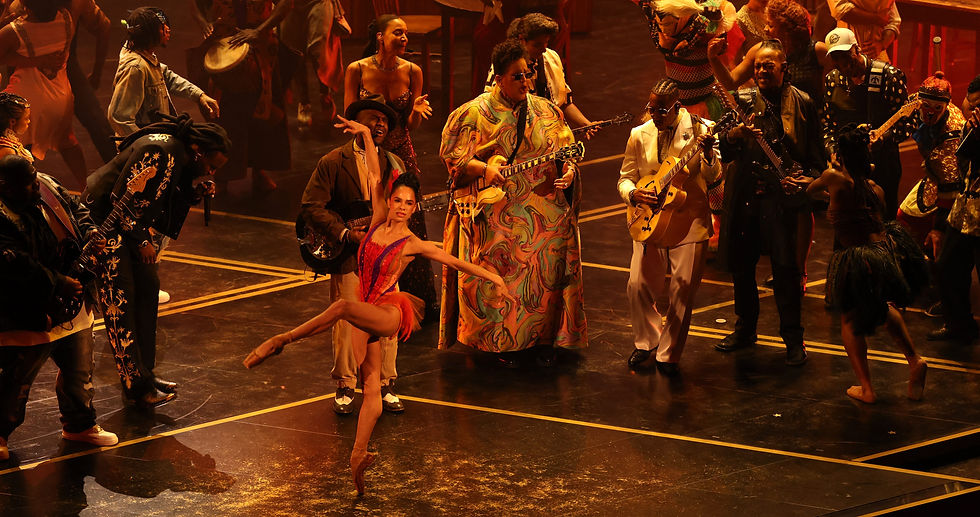
Black ballerina Misty Copeland pushed back on it, pointing out that film doesn’t really sit on its own, that acting borrows from traditions like ballet and opera whether it wants to or not. Then, at the Oscars, she appeared again, this time moving across the stage during a performance from Sinners, a film set in the Jim Crow South, built around blues, folklore, Black cultural memory. Ballet, but pulled somewhere else. Not quite where people expect it to be.
In 1781, a 14-year-old girl made her debut as an opera soloist in Saint-Domingue. She was a free person of colour, and for the first few years of her career, she wasn’t named in print. Just “the young person”. Announcements, listings, nothing much to hold onto.
Her name came later. Minette Ferrand. A main singer in Port-au-Prince, widely recognised at the time, though you wouldn’t necessarily know it from what’s left behind in history.
That erasure of Black art comes up again and again.
Black women in classical music tend to sit in fragments. First names, initials, partial credits. Enough to suggest something was happening, not quite enough to make it feel continuous or over consequential.
“Opera has never been White,” as Givonna Joseph puts it. It isn’t really a dramatic statement, more a correction. The work was there, she says. It just didn’t always make it through.
New Orleans had five opera houses operating at once between the late 18th and early 20th century, staging European works while a separate network of Black and interracial musicians moved across the same city. Performers, composers, teachers who were not necessarily in the same spaces, but close enough. Some of this creativity and talent has stood the test of time. A lot of it didn’t.
Sister Marie Seraphine was composing and directing orchestras in the early 1900s, teaching music to orphans, slowly building a successful music career. When her convent relocated, most of her work was lost. Camille Nickerson spent years collecting and arranging Afro-Creole songs, pulling them into a classical framework. A lot of that material is now out of print or hard to track down. Shirley Graham Du Bois staged an opera, Tom-Toms, in 1932, performed by an all-Black cast and orchestra and moving from an African tribe to a slave plantation and then 1920s Harlem. It played to crowds of thousands. It ran twice. Then it closed, and slowly slipped out of view until someone found a score decades later.
Ballet tells a similar story.
In 1946, Les Ballets Nègres was founded in London. The first Black ballet company in Europe. It toured internationally, building a repertoire that moved between classical technique and Caribbean and African influences, and performances of They Came and Market Day were even broadcast by BBC in 1949. Despite the early success, the company disbanded in 1953 due to lack of funding.
Access plays a lot into Black dancers getting equal opportunities. Training schools, companies, casting– all of it shaped by institutions that decide who fits. For Black dancers, that line tends to appear early and it tends to be white.
In 1985, Noel Wallace joined London Festival Ballet. The first Black male dancer in the company. By this point Les Ballets Nègres had been founded almost 40 years prior. Wallace was initially rejected after auditioning for the role depsite his talents. However, around this time, the company was reportedly under pressure to diversify or risk losing funding. He was hired soon after.
“It was hard to fit into a company,” he later said. “But I stuck to it.”
As the first Black principal Ballerina at the American Ballet Company, Misty Copeland has talked about spending years as the only Black woman in a company of nearly 100 dancers. Ballet is built on uniformity, on bodies that match, lines that disappear into each other. Even the costumes assume a particular skin tone. She’s described being passed over for roles because she would “stand out too much”.

Copeland’s experience is not new by any means. It’s an excuse that has led to hundreds of years of Black history being erased until it suits those in power. By the time Marian Anderson stepped onto the stage at the Metropolitan Opera in 1955, it was framed as a breakthrough. The first Black singer to perform there.
16 years earlier, she had been barred from singing at Constitution Hall. They wouldn’t allow her to perform because of racial segregation laws. She performed instead on the steps of the Lincoln Memorial, in front of 75,000 people.
The work for Black artists didn’t stop there. It didn’t start there either.
It just hasn’t always been the version that gets carried forward.


Comments